Research by Women in the Proceedings from 1900–50
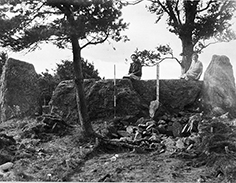
Old Keig, recumbent stone circle. Excavation photograph. Dr Margaret E C Stewart is in the centre of the photograph © Courtesy of HES (Vere Gordon Childe Collection).
Since 1851, the Proceedings of the Society of Antiquaries of Scotland (PSAS) has published academic articles covering all aspects of Scotland’s past, with the aim of furthering understanding of Scotland’s heritage. Women have been involved in the Proceedings since 1862 and the Society is proud of publishing a plethora of research papers by female scholars. This collection of articles reflects research by women in the Proceedings from 1900–50.
Throughout the first half of the 20th century, archaeology developed into a professionalised discipline with the establishment of new technology and university programmes. As a result, female intellectuals were engaged in a relatively new and primarily masculine field, in which gendered stereotypes and expectations influenced their careers (Carr 2012: 1). By presenting these papers, the lives, accomplishments, and academic careers of female scholars can be celebrated.
The beginning of the 20th century was an exciting time for women in the Society. In 1901, women were admitted as Fellows on the same standing as men, and no longer as Lady Associates, which resulted in increased publications by female authors (Holder 2021) Consequently, the scope of women’s research expanded, which is reflected in the extensive range of topics featured, from Anglo-Saxon burghs to chambered cairns. Likewise, the papers cover a wide time period, from prehistoric to the 16th century. Geographically, the papers are spread across Scotland, from the Scottish Borders to Orkney, with Ella S Armitage placing Scottish archaeology in a wider European context. These varied topics, time periods, and sites reflect the broad geographical and cultural scope of women’s research in the early 20th century and the significance of their work.
Considering the variety of research conducted by women from 1900–1950, the present issue is not intended to be a comprehensive list of every female contributor to the Proceedings throughout this period. Instead, it is a collection presenting selected research papers authored by women in the given time period, with the aim of highlighting their individual and collective contribution to studies of the past.
Naturally, some of the most established female scholars are included for their lasting contribution to the field. Sylvia Benton’s 1928–30 excavation of Sculptor’s Cave continues to be the basis for later scholars’ work, including the 2020 book Darkness Visible: The Sculptor’s Cave, Covesea, from the Bronze Age to the Picts by Ian Armit and Lindsey Büster. Similarly, Cecily Margaret Piggott, whose research on Iron Age hillforts cemented her as one of the 20th century's most eminent prehistorians. Also featured is Margaret Crichton Mitchell, who completed her PhD under Gordon Childe and was the first female Honorary Fellow of the Society. Margaret also collaborated with Alison Young to lead the excavations at Monzie, Perthshire in 1938–9.
Several of the women included in this issue led excavations across Scotland. Louisa Duff-Dunbar was an archaeological collector and writer, who led excavations in the north-east. Dorothea M A Bate was a Welsh palaeontologist and archaeozoologist, who excavated a burial site in the south-west of Scotland. Phoebe A M Keef was well-known for excavating in Sussex but is featured here working on Chester Hill in the Scottish Borders.
Other women contributed to post-excavation research, often at the forefront of developments in their specialism. Mary E Boyle used her expert knowledge of stone carvings and iconography to propose a new date for four sculptured stones in Scottish graveyards. Grace Mary Crowfoot was a pioneer of archaeological textiles from the National Museum in Edinburgh. Margery I Platt was the first female curatorial staff member in the Natural History department of the National Museum and worked to identify the archaeological remains of animals. Scottish historical studies also benefited from women’s research. For example, two major forces in Anglo-Norman studies, Ella S Armitage and Mary D Legge published on architectural and linguistic history respectively.
When creating this issue, the archive was critically examined to excavate the work of more obscure women and to avoid cherry-picking only the best-known authors (Browman 2013: 5). Although little is known about Jeanette M Hanna and Laura E Start besides their individual research papers, their contribution to the understanding of Scotland’s past should still be recognised.
Numerous other Proceedings papers by women could have been included, but it is hoped the selected papers will encourage future research into women’s involvement in the Society. It is the ambition of this collection to provide an indication of the scope and depth of scholarship published by women in the first half of the twentieth century, and to bring their contribution to studies of the past to light.
Amy-Jo Kearton FSAScot, work placement at the Society of Antiquaries of Scotland, Summer 2023
Keywords: women in archaeology, professional archaeology 20th century
Bibliography
Browman, D L 2013 Cultural Negotiations: The Role of Women in the Founding of Americanist Archaeology, 5. Lincoln: University of Nebraska Press.
Carr, L 2012 Tessa Verney Wheeler: Women and Archaeology Before World War Two, 14. Oxford: Oxford University Press.
Holder, J 2021 ‘Women Collectors, Lady Associates and the Society of Antiquaries of Scotland,’ History Journal, https://historyjournal.org.uk/2021/12/16/women-collectors-lady-associates-and-the-society-of-antiquaries-of-scotland/ [accessed 10 July 2023]
‘Proceedings (PSAS),’ Society of Antiquaries of Scotland, https://journals.socantscot.org/index.php/psas [accessed 10 July 2023]
Anglo-Saxon Burhs and Early Norman Castles
Ella Sophia Armitage
Volume 34, 260–88
Notice of the Excavation of a Cairn at Mossknowe, on the Kirtle Water, Dumfriesshire
Dorothea M A Bate
Volume 43, 165–69
Notes on the Royal Heart Preserved at St Margaret’s Convent, Whitehouse Loan, Edinburgh
Jeanette M Hanna
Volume 51, 16–25
Notes on a Chalice Veil in the National Museum of Antiquities
Laura E Start
Volume 55, 261–64
The Nether Largie Chambered Cairn, Kilmartin, Argyll
Margaret E Crichton Mitchell
Volume 64, 233–43
The Excavation of the Sculptor’s Cave, Covesea, Morayshire
Sylvia Benton
Volume 65, 177–216
A Fort at Skitten, Wick, Caithness, with Notes on Flint Implements from the Same County
Louisa Duff-Dunbar
Volume 69, 108–17
Reindeer Antlers from Rousay, Orkney
Margery I Platt
Volume 70, 435–41
Suggestions for the Dates of Four Scottish Monuments
Mary E Boyle
Volume 72, 115–21
Report on Excavation at Monzie
Alison Young and Margaret E Crichton Mitchell
Volume 73, 62–70
Excavations at Chester Hill Fort, Hundleshope, in Manor Parish, 1939
Phoebe A M Keef
Volume 80, 66–73
The Inauguration of Alexander III
Mary Dominica Legge
Volume 80, 73–82
Two Textiles from the National Museum, Edinburgh
Grace Mary Crowfoot
Volume 82, 225–31
The Excavations at Howman Rings, Roxburghshire, 1948
Cecily Margaret Piggott
Volume 82, 193–225