An Introduction to Scottish Environmental History
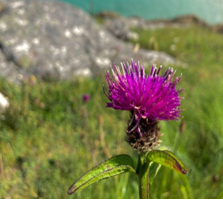
Thistle, Achmelvich © Gabrielle Hill-Smith.
Throughout the history of the Proceedings, Scotland’s diverse environment has long captured the attention of readers and contributors. Through three thematic chapters, this virtual journal offers an introduction to the rich seam of research which explores interactions between people and the environment in Scottish history. These articles were selected for their chronological and disciplinary breadth. Bringing together the expertise of historians, geographers, archaeologists, environmental scientists, and more, this virtual journal covers exciting areas of research which have developed over the last two centuries, including archaeobotany, palynology, dendrochronology, geoarchaeology, micromorphology, and radiocarbon-dating.
1. Prehistoric Environments
Opening with ‘Moments of Crisis: Climate Change in Scottish Prehistory (2013) by Richard Tipping et al, introduces a recurring thematic interest in how past societies navigated changing environments. The authors argue Scotland provides a unique resource to ‘better understand the nature and timing of abrupt climate change of the landscape and the prehistoric societal response to [...] resource fluctuations’ by ‘integrat[ing] archaeological evidence with palaeoenvironmental data’ (18). Co-author Jeff Sanders tells me their research developed from a ScARF workshop connecting leading paleoclimatologists and archaeologists. He says it ‘highlighted the dynamism of prehistory’, showing how early peoples were adapting and responding to a changing environment, lending insights which remain relevant in the ongoing climate crisis. He also emphasised that since 2013, changing technologies have improved the research landscape of the discipline, allowing increased interdisciplinary integration, which was only just beginning at the time of this article. Prehistoric Scotland’s changing environments are also investigated by Thomas Affleck et al in their 1989 article which investigates a Mesolithic occupation site on Arran, including palynological samples which indicated an unexpected ‘environmental richness’, and possible anthropogenic vegetation change over time (57). Similarly, the next two articles by geographer Graeme Whittington, use palynology to understand prehistoric human-plant interactions. His 1994 article discusses how meadowsweet pollen found in the Kingsbarn graves indicates (when in season) meadowsweet flowers were deposited in these graves. Whittington (with Jack Jarvis) also investigates Kilconquhar Loch’s origins, noting the importance of palynological investigations, in beginning to understand the history of human-plant interactions, but also establishing the discipline's limitations. Kevin J Edwards and Ian Ralston’s 1985 paper also examines vegetation change in Scottish prehistory, concluding that while it is possible to identify human influence on natural resources on a small site-specific scale, it is difficult to see the bigger picture of anthropogenic vegetational change in the Mesolithic. The next three articles focus on prehistoric subsistence strategies. In their 2010 article, Alastair Becket and Gavin MacGregor from GUARD discuss their 2007 archaeological investigation of pits and a hearth at Maybole, including Jennifer Miller’s archaeobotanical analysis, which confirms ‘food plant remains’ (112) were found. The paleoenvironmental data evidences the ‘exploitation of wild plants and cereal cultivation’, as well as ‘seaweed harvesting and keeping of livestock’ (119), providing scholars with a unique ‘opportunity to examine the inter-relationships of human, animal and the environment’, in a period of dynamic change (120). Rosie Bishop, Mike Church and Peter Rowley-Conwy from the Department of Archaeology at Durham University, published two papers on food in the Scottish Neolithic (2010) and Mesolithic (2014) – which discuss the importance of plants in prehistoric communities. The first article concludes that in Neolithic Scotland, cultivated barley, ‘supplemented’ with nuts and wild fruits, was the dominant food, but ‘plant exploitation was geographically, socially and chronologically diverse’ across Scotland (89–90). The second article also suggests plants, in particular hazelnuts, were key subsistence resources in the Mesolithic, and that ‘evidence for plant use was more widespread on Scottish Mesolithic sites’ than previously understood (56–57).
2. Flora on the Frontier
These two articles introduce the topic of environmental history and the Antonine Wall, as an example of the many papers on the second-century ad Roman fortification in the Proceedings. The 1999 article by archaeologists Andrew Dunwell and Geraint Coles, details a CFA excavation conducted before pipeline construction around the Antonine Wall, near Kirkintilloch. Their work gives insight into ‘the variations and local adaptation to topography employed by the builders’ of the wall, and their palynological analysis reveals 600 years of vegetation change, including periods of deforestation and regeneration, and previously unknown patterns of cultivation (477). The 2022 article ‘‘Another Wall of Turf’’, produced by an interdisciplinary team from the University of Edinburgh, explores the findings of geoarchaeological analysis conducted at the Antonine Wall. Their work reveals how the wall was constructed from turf sourced from different localities, and argues for ‘the need to routinely apply micromorphology when investigating earthen monuments’, showing how dynamic and exciting continued developments in Scottish environmental history can be (133).
3. Deforestation and Dendrochronology
This final chapter explores the rich history of Scotland's forests and woodlands. AOC archaeologist Anne Crone’s synthesises dendrochronological work from 250–752 ad Scotland, in her 1999 article, discussing how it can reveal socio-economic conditions. Crone’s later article, co-authored with Coralie M Mills, also uses dendrochronological evidence, analysing 15th–19th century structures, as a proxy for timber trade, and revealing patterns of imported Scandinavian timber. They argue how dendrochronology brings documentary sources ‘to life’, allowing wood from supposedly ‘unimportant’ buildings to ‘contribute to the wider national story of woodland use and timber trade’ (365). Richard Tipping, who co-authored the first paper in this virtual journal, also wrote ‘The Form and the Fate of Scotland's Woodlands’ (1995), an attempt to reconstruct the distribution and composition, and deforestation, of Scotland's woodlands in the Holocene. He calls for continued improvement of environmental history and palynological analysis of Scotland’s past, noting the method’s spatial and temporal ‘flexibility’ as an advantage. John M Gilbert’s 2017 article explores woodland management in Scotland from the 12th–16th centuries using mostly documentary evidence, investigating how, and by whom, medieval woodlands were managed. He also notes the apparent shortage of timber in Scotland from the 14th century onwards. We end with Arthur Mitchell’s 1864 article which argues that an ancient forest once grew along the River Cree, drawing on the archaeobotanical remains of submerged tree trunks found in the river bed, as well as several artefacts including oak canoes and various stone tools. Written more than 160 years ago, Mitchell’s article highlights the continued relevance of the Proceedings’ archives. Poignantly reflecting on human interactions with changing landscapes through time, he imagines how ‘our children’s children may see green fields again where old Wigtown stood’ (23), allowing us to think about the ways in which Scotland’s environment, and our relationship with it, continues to change.
Gabrielle Hill-Smith, work placement at the Society of Antiquaries of Scotland, Spring 2025
Keywords: Archaeobotanical, paleoenvironmental, climate change, prehistory, Neolithic, Mesolithic, Bronze Age, Roman, medieval, woodlands, timber, forestry, food, agriculture, cultivation, farming, dendrochronology, plants, flora, palynology, pollen, deforestation, changing environments, radiocarbon dating, archaeology, buildings, adaptations, peat
1. Prehistoric Environments
Moments of crisis: climate change in Scottish prehistory
Richard Tipping, Richard Bradley, Jeff Sanders, Robert McCulloch and Robert Wilson
Volume 142, 9–25
Thomas L Affleck, Kevin Edwards and Ann Clarke
Volume 118, 37–59
Palynological investigations at two Bronze Age burial sites in Fife
Graeme Whittington
Volume 123, 211–13
Kilconquhar Loch, Fife: a historical and palynological investigation
Graeme Whittington and J Jarvis
Volume 116, 413–28
Postglacial hunter-gatherers and vegetational history in Scotland
Kevin J Edwards and Ian Ralston
Volume 114, 15–34
Forest grazing and seaweed foddering: early Neolithic occupation at Maybole, South Ayrshire
Alastair Becket and Gavin MacGregor
Volume 139, 105–22
Cereals, fruits and nuts in the Scottish Neolithic
Rosie R Bishop, Michael J Church, and Peter A Rowley-Conwy
Volume 139, 47–103
Seeds, fruits and nuts in the Scottish Mesolithic
Rosie R Bishop, Michael J Church, and Peter A Rowley-Conwy
Volume 143, 9–71
2. Flora on the Frontier
Andrew Dunwell and Geraint Coles
Volume 128, 461–79
Tanja Romankiewicz, Ben Russell, Geoff Bailey, Tom Gardner, James R Snyder and Christopher T S Beckett
Volume 151, 103–41
3. Deforestation and Dendrochronology
The development of an Early Historic tree-ring chronology for Scotland
Anne Crone
Volume 128, 485–93
Timber in Scottish buildings, 1450–1800: a dendrochronological perspective
Anne Crone and Coralie M Mills
Volume 142, 329–69
The form and the fate of Scotland's woodlands
Richard Tipping
Volume 124, 1–54
Woodland management in medieval Scotland
John M Gilbert
Volume 146, 215–52
On the Vestiges of the Forest of Cree, in Galloway
Arthur Mitchell
Volume 5, 20–33