Alexander Henry Rhind
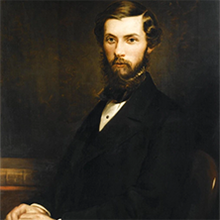
Portrait of Alexander Henry Rhind of Sibster, oil on canvas, by Alexander S. Mackay, 1874. Museum reference H.OD 7.
Alexander Henry Rhind (1833–63) was a ground-breaking Scottish archaeologist. He was particularly interested in excavating prehistoric sites in Scotland and was one of the earliest exponents of scientific techniques and methodology in archaeological excavations (in 1853, he became the first person to systematically excavate a broch). He was a Fellow and Honorary Member of the Society of Antiquaries of Scotland, and National Museums Scotland credits him as the ‘first experienced archaeologist to excavate in Egypt’.
Rhind was born in 1833 and was educated in Wick and at the University of Edinburgh, where he read Natural History and Natural Philosophy. He also attended lectures by Cosmo Innes on Scottish History and Antiquities because of his strong personal interest in these subjects.
He involved himself in the study of his native Caithness and in 1851 opened a number of chambered tombs, including those at Yarrows.
In 1853 he investigated the broch at Kettleburn – a report on which was published in in Volume One of the Proceedings. The finds from the broch were also presented to the Society, Rhind having been elected a Fellow in 1852 and becoming an Honorary Member in 1857, aged only 24. He was subsequently called upon to advise the Society on the organisation of the exhibits in its Museum.
In 1853, his deteriorating health led him to move to England, making his home near Bristol, and from then on he only visited Wick in the summer. Nearly every winter he went abroad, primarily in Egypt, to pursue his antiquarian interests.
Rhind was a prolific donor of both Scottish and foreign antiquities to the National Museum here in Edinburgh, including many important items he discovered or bought in Egypt such as a bilingual papyrus and the finds from a tomb he excavated.
While in Egypt he acquired what is now known as the Rhind Mathematical Papyrus, which was sold after his death to the British Museum. The Rhind Papyrus featured in Neil MacGregor’s History of the World in 100 Objects; it dates to around 1550 bc and has been dubbed ‘the most significant mathematical document from ancient Egypt’.
Rhind was an active writer of papers, memoranda, and letters. His magnum opus – the book on his work at Thebes in Egypt – was published in 1862 shortly before his death.
Rhind died at Zurich in 1863, some 23 days short of his 30th birthday, and was buried in the family burial ground at Wick. Among his many bequests he was very generous to our Society, including gifting his library of around 1,600 volumes, a sum of £400 for excavation in northern Scotland, and the profits and copyright of his book on Thebes.
As part of his bequest, Rhind also indicated that any money made from the sale of his estate at Sibster should be used to fund the lecture series that still perpetuates his name. And so, since the first lecturer was appointed in 1874, the lectures have enabled speakers to present, ‘a course of not less than six lectures on some branch of archaeology, ethnology, ethnography, or allied topic, in order to assist in the general advancement of knowledge’.
In the years since his death, the Society has hosted Rhind Lectures on topics such as medieval Edinburgh, the early art of Scandinavia, 18th-century architecture in Britain, Mayan archaeology, and the archaeology of the African diaspora.
A full list of past Rhind lecture topics is available on Wikipedia and recordings of Rhind Lectures since 2014 are available on our YouTube channel, including Dr Margaret Maitland’s 2015 Rhind Lectures on the man himself.
This virtual journal issue is primarily comprised of papers from the mid-19th century, covering Rhind’s research interests in life and notes of his contributions to the study of Scotland’s past after his death.
Rhind authored eight papers in PSAS between 1854 and 1862 including reports of excavations in Caithness, studies on the peoples of Roman Scotland, and the technologies and burial practices of the ancient Egyptians.
This virtual issue also contains papers offering a glimpse into Rhind’s opinions on antiquarianism and the study of archaeology, including a notice encouraging Scottish landowners to preserve the historical and archaeological artefacts found on their land, and papers discussing the role of antiquaries in the study of the past, the display of historical artefacts to the public and comments on the treasure trove system.
It also includes a notice of his death and details of the bequests he made to the Society in his will.
Finally, in 2016 Clair Gilmour discussed Rhind’s legacy in her paper ‘Alexander Henry Rhind (1833–63): a Scottish antiquary in Egypt’.
Sally Pentecost FSAScot, Communications & Events Officer, Winter 2025
Keywords: Alexander Henry Rhind, archaeology, Society of Antiquaries of Scotland, Kettleburn broch, Caithness, Egyptology, Thebes: Its Tombs and Their Tenants, the Rhind lectures
Bibliography
Alexander Henry Rhind: The first experienced archaeologist to excavate in Egypt, https://www.nms.ac.uk/discover-catalogue/alexander-henry-rhind-the-first-experienced-archaeologist-to-excavate-in-egypt
McElroy, K 2022 Amazing Antiquarian #1: Alexander Henry Rhind, https://www.thebrochproject.co.uk/blog/amazing-antiquarian-1-alexander-henry-rhind
Object: The Rhind Mathematical Papyrus, British Museum, https://www.britishmuseum.org/collection/object/Y_EA10058
Rhind Lectures, https://www.socantscot.org/what-we-do/rhind-lectures/
Rhind Lectures, Wikipedia, https://en.wikipedia.org/wiki/Rhind_Lectures
Society of Antiquaries of Scotland Youtube channel, https://www.youtube.com/@SocietyofAntiquariesofScotland/featured
Anniversary Address: 30 November 1852
Volume 1, 97–101
Alexander Henry Rhind
Volume 1, 182–190
Alexander Henry Rhind
Volume 1, 264–269
On the Bronze swords occasionally attributed to the Romans
Alexander Henry Rhind
Volume 2, 72–75
British Primeval Antiquities: Their present treatment and their real claims
Alexander Henry Rhind
Volume 2, 2–101
Meeting Notes: 11 February 1856
Volume 2, 176–177
Alexander Henry Rhind
Volume 2, 274–276
Notes of excavations of Tumuli in Caithness, made in the Summer of 1856
Alexander Henry Rhind
Volume 2, 372–379
Anniversary Meeting: 30 November 1857
Volume 3, 1–8
The Law of Treasure-Trove: How it can be best adapted to accomplish useful results
Alexander Henry Rhind
Volume 3, 76
On the Use of Bronze and Iron in Ancient Egypt, with reference to general Archaeology
Alexander Henry Rhind
Volume 3, 464–465
Anniversary Meeting: 30 November 1863
Volume 5, 169–189
John Stuart
Volume 7, 289–307
Anniversary Meeting: 30 November 1874
Volume 11, 1–21
Bonus
Alexander Henry Rhind (1833–63): a Scottish antiquary in Egypt
Clair Gilmour
Volume 145, 427–440